Laser hair removal is not finished in one visit. It has to be repeated several times at intervals of 4 to 6 weeks before hair becomes thinner and less of it grows back. This article explains how laser hair removal works, how many sessions are needed and how far apart, and how to care for the skin before and after treatment. People respond very differently, so the number of sessions cannot be fixed in advance. Still, many people see little change for the first 3 to 4 sessions, and hair often starts to become finer from session 5 or 6.
How does laser hair removal reduce hair?
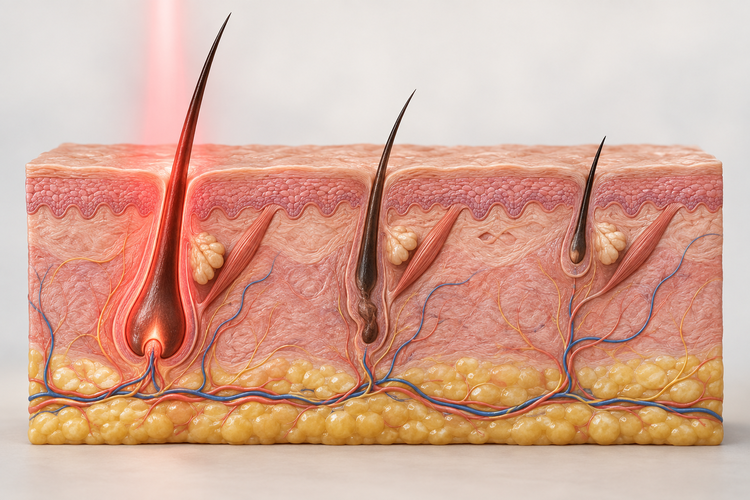
The lasers used for hair removal are absorbed selectively by melanin pigment. The laser energy travels through the melanin in the hair down to the follicle and destroys the tissue that produces the hair. Shaving and waxing only remove the hair that shows above the skin. Laser hair removal is different because it acts on the root, where the hair grows.
Waxing and shaving are convenient, but each time they put physical stress on the skin. This can lead to other skin problems such as ingrown hairs, folliculitis and pigmentation. After several laser sessions, a long-lasting reduction in hair can be expected, so people who want to avoid this repeated irritation often look into it.
- Waxing — wax is applied and pulled off, which irritates the skin strongly and can cause ingrown hairs or folliculitis
- Shaving — the razor scrapes across the skin, which causes irritation and can leave pigmentation or a visible beard shadow
- Laser hair removal — destroys the hair follicle, so several sessions can be expected to give a long-lasting reduction
How many sessions of laser hair removal are needed, and how many weeks apart?
Hair goes through a cycle of growth, regression and resting phases. The laser works most effectively in the growth phase, when the follicle is actively producing hair, so a single treatment only affects the hairs that are growing at that moment. This is why laser hair removal is split into repeated sessions at intervals of 4 to 6 weeks: each session targets the hairs that have entered the growth phase since the last one.
The number of sessions needed depends on hair thickness, skin color and hair density, and it varies a great deal between people, even for the same body area. Up to session 3 or 4, it can feel as if the hair is growing back, and this is a normal part of the process. Many people notice coarse hair thinning to something like fine vellus hair around session 5 or 6, so it is wise not to judge the results too early.
What should be followed to make laser hair removal more effective?
The laser targets the melanin in the hair. If waxing pulls the hair out by the root before treatment, there is nothing left to absorb the energy, and the laser has almost no effect. After waxing, it is advisable to wait for a period of time before treatment. If the skin has darkened from tanning, the melanin in the skin can also absorb the energy and there is a risk of burns, so a break is needed before treatment.
Right after laser hair removal, the skin has been stressed by the laser energy, and even a little heat or friction can easily leave redness or pigmentation. For this reason, aftercare matters as much as the treatment itself, and the four rules below are worth checking again after every session.
- Avoid heat — hot showers, saunas and steam rooms make the irritated skin more sensitive, so they should be avoided
- Watch out for friction — do not touch the treated area or rub it with peeling products or exfoliating towels
- Sun protection — apply sunscreen to the treated area to prevent pigmentation
- Moisturizing — apply plenty of moisturizer to soothe the irritated treated area