Ultracol 100 and 200 are easily misunderstood, as if a higher number meant a better product, but the difference between the two lies not in grade but in PDO dose and particle size. Ultracol 100 often suits concerns about fine lines and skin texture, while Ultracol 200 often suits concerns about deep wrinkles and volume. This article sets out how the two products work, how they differ, how to choose between them and the treatment interval.
How does Ultracol work?
PDO, the main ingredient of Ultracol, is commonly used in thread lifting; it is highly biocompatible and stimulates fibroblasts when injected into the dermis. In a way similar to how collagen is produced as the threads dissolve and disappear in thread lifting, Ultracol is also a treatment that induces collagen production over time.
Behind the attention collagen boosters are receiving is a change in how fillers are perceived. Fillers have long been used for hollow areas, but more people now want changes that are not noticeable because fillers can feel artificial or like a foreign body, and in many cases they have turned to collagen boosters as an alternative.
What is the difference between Ultracol 100 and 200?
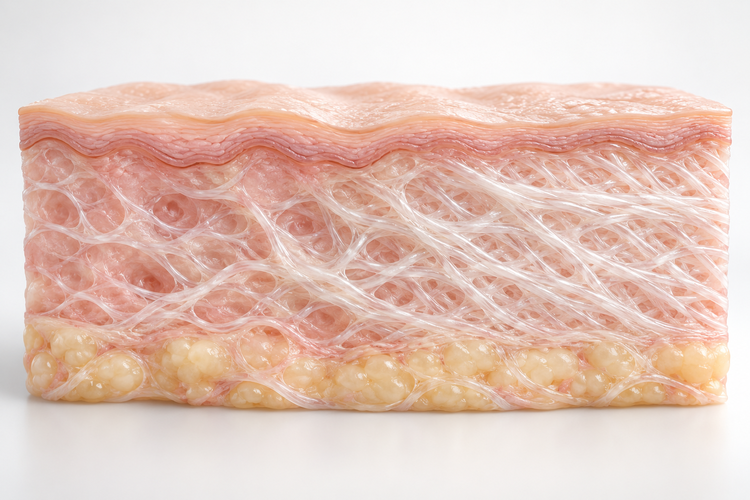
The 100 and 200 in Ultracol are not grades but labels distinguishing PDO dose and particle size, in the same way that Juvelook Skin and Juvelook Volume are divided by particle size. The larger the particles, the more collagen is produced, while smaller particles allow delicate treatment of sensitive, thin skin.
If Ultracol 100 is chosen for a concern that needs Ultracol 200, the effect may not be as strong as expected. Because the suitable candidate differs by particle size, when the concern is clear, such as deep wrinkles around the nasolabial folds, the product should be decided after an in-depth consultation with the medical team.
- Ultracol 100 particles — small at 20 to 50 μm, allowing delicate treatment of thin skin
- Ultracol 200 particles — larger at 50 to 100 μm, producing more collagen
- What the two products share — both are PDO-based, and the difference lies in dose and particle size
When is Ultracol 100 or 200 the right choice?
Ultracol 100 is mainly used for fine lines, rough skin texture and enlarged pores in thin, delicate areas such as around the eyes, around the mouth and the neck. Ultracol 200 is used on nasolabial folds, hollow cheeks and under-eye grooves, with the aim of improving deep wrinkles, adding volume and refining contours.
Where needed, Ultracol can be combined with other skin boosters or lifting treatments for more efficient care. However, rather than simply following a product that others have recommended, it is advisable to first check one's own skin condition and the desired change, and then decide on the treatment combination.
- Concerns for Ultracol 100 — chosen for skin tone, rough texture, fine lines and enlarged pores
- Areas for Ultracol 100 — used on thin, delicate areas such as around the eyes, around the mouth and the neck
- Concerns for Ultracol 200 — chosen when volume is lacking, as with deep nasolabial folds or hollow cheeks
How many Ultracol sessions are needed, and at what interval?
Ultracol is a treatment in which collagen forms gradually from around 4 to 6 weeks after the treatment. The average schedule is about 3 sessions at intervals of around 4 weeks at first, followed by a session every 6 months to maintain the effect, but because there are individual differences, a treatment plan suited to each person needs to be made separately.
Because Ultracol is basically given by injection and puts stress on the skin, it is advisable to avoid drinking and smoking as much as possible after the treatment. Applying sunscreen without fail to protect the skin from ultraviolet rays is also basic aftercare to follow after the treatment.