Centum Lily Clinic Doctor's Column
Dermatology & Aesthetics Column

Why Does Cheek Hollowing Happen After Ultherapy, and How Can It Be Avoided?

Why cheek hollowing can appear after Ultherapy, and how choosing tips for each skin layer and assessing each person individually help to avoid it.

Published 2026-11-16 Updated 2026-11-16 Reviewed by Hyeran Heo, Medical Director

Ultherapy is a lifting treatment that uses HIFU focused ultrasound to raise sagging facial contours, yet concern about cheek hollowing often comes with it. This article covers how Ultherapy works, why cheek hollowing occurs and what to check before treatment. In short, cheek hollowing is a problem that arises when strong energy is delivered uniformly to areas with little fat. It can generally be avoided by assessing the degree of sagging, elasticity and fat distribution in each person and designing the treatment to match.

01

How does Ultherapy lift sagging skin?

Key point
Ultherapy gathers HIFU focused ultrasound energy at one point and delivers it as deep as the SMAS fascial layer, where heat of about 60 to 70 degrees creates thermal coagulation points that contract loose tissue. Collagen regeneration is then stimulated, and the facial contour becomes firmer.

Lifting treatments mainly use either HIFU ultrasound energy or RF radiofrequency energy. Both aim to improve elasticity and lift the skin, but they differ in the depth and manner in which the energy acts. Ultherapy is a HIFU device: much as a magnifying glass gathers sunlight into a single point, it concentrates ultrasound energy at a specific depth.

The SMAS layer is a fibrous fascial layer beneath the skin that strongly influences skin elasticity. When Ultherapy delivers energy to this layer and forms thermal coagulation points, loose tissue contracts, and regeneration of collagen and elastin in the dermis follows. Because only specific depths are targeted, a tightening effect can be achieved while reducing damage to the surrounding tissue.

  • Sagging facial lines — as the fascial layer contracts, loose contours are drawn upward
  • Sagging double chin — loose tissue under the chin firms up and the jawline becomes more defined
  • Forehead, eye — area and nasolabial wrinkles — wrinkles become fainter as collagen regeneration is stimulated
  • Skin remodeling — collagen and elastin regenerate and the skin becomes firmer overall
Anatomy illustration related to Why Does Cheek Hollowing Happen After Ultherapy, and How Can It Be Avoided?
02

How does Ultherapy distinguish between skin depths during treatment?

Key point
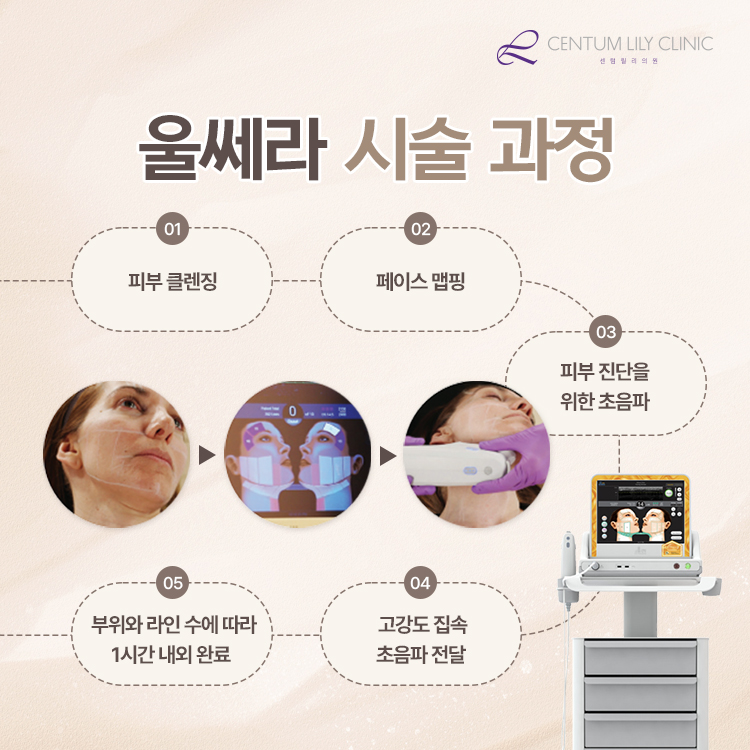
Ultherapy uses Deep See ultrasound imaging, which shows the positions of the dermis, subcutaneous fat layer and fascial layer in real time during treatment. Dedicated 1.5mm, 3.0mm and 4.5mm tips are used according to the purpose and area, so that energy is aimed at each layer separately.

Distinguishing the skin layers during Ultherapy is not left to the medical team's intuition alone. Deep See ultrasound imaging monitors skin depth and structure in real time, so the positions of the dermis, subcutaneous fat layer and fascial layer can be checked directly and targeted, and energy can be carefully distributed by area.

Each dedicated Ultherapy tip plays a different role according to its depth. A dermal tip is chosen for shallow wrinkles, a fat-layer tip for reducing unnecessary fat, and a fascial-layer tip for lifting sagging contours. The treatment is refined by selecting the tip that suits the purpose and the area, one step at a time.

  • 1.5mm tip — for the dermis, focusing on wrinkles around the eyes and mouth and on skin texture
  • 3.0mm tip — for the subcutaneous fat layer, used to selectively reduce unnecessary fat
  • 4.5mm tip — for the SMAS fascial layer, targeting the layer that is lifted in a facelift
Anatomy illustration related to Why Does Cheek Hollowing Happen After Ultherapy, and How Can It Be Avoided?
03

When does cheek hollowing occur after Ultherapy?

Key point
Cheek hollowing after Ultherapy can occur when strong energy is delivered to an area with little fat. It is a typical side effect of uniform treatment, in which the same number of shots, energy strength, tips and treatment areas are applied to everyone.

Ultherapy can reduce fat by targeting the subcutaneous fat layer, so people who are slim or have little cheek volume often worry that their cheeks will sink after treatment, and accounts of cheek hollowing are easy to find online. This concern is partly justified, but the cause of cheek hollowing lies more in how the treatment is designed than in the device.

To avoid cheek hollowing, slim people need not be ruled out on body type alone. Instead, the degree of sagging, elasticity and fat distribution should be assessed closely for each person, and a tailored lifting plan should separate areas where fat loss must be avoided from areas where elasticity needs to be improved. The medical team's assessment and skill in making that distinction shape the result.

Hyeran Heo, Medical Director
Doctor's view

How the doctor decides

Hyeran Heo, Medical Director

I do not rule out Ultherapy because a face is slim

I fully understand why people with little cheek volume worry about hollowing. Even so, I do not tell anyone that Ultherapy is unsuitable simply because they are slim. Cheek hollowing is a problem that arises from uniform treatment, not a fixed outcome for a slim face.

I first look at where the fat is and how much there is

Before planning treatment, I look at how fat is distributed across the face. In some areas fat loss must be avoided, and in others elasticity needs to be improved. Because strong energy delivered to an area with little fat can cause cheek hollowing, I put great care into the assessment that draws that boundary.

I do not apply the same shots and tips to everyone

Applying the same number of shots, energy strength, tips and treatment areas to everyone raises concerns about side effects. I distribute the 1.5mm, 3.0mm and 4.5mm tips by area according to facial structure, individual features and the change each person hopes for. I believe the precision of the lifting is what determines the result.

Summary

In summary

Cheek hollowing is less a problem of Ultherapy itself than of strong energy being applied uniformly to areas with little fat. For those concerned about sagging contours but hesitant because of low cheek volume, it is advisable to have the degree of sagging, elasticity and fat distribution assessed before treatment. After treatment, it is also worth checking whether a genuine-treatment certificate and sticker are issued.

FAQ

Frequently asked questions

QCan slim people with little cheek volume have Ultherapy?
A

Yes. Cheek hollowing occurs when strong energy is delivered to areas with little fat, so the key is a tailored plan that first assesses fat distribution and then adjusts the energy and tips by area.

QHow can someone confirm that the Ultherapy treatment is genuine?
A

Check whether a genuine-treatment certificate and sticker are issued after the procedure. Genuine Ultherapy delivers energy evenly, which is what allows safety and results to be expected.

QHow should swelling or bruising after Ultherapy be managed?
A

Swelling or bruising may appear right after treatment and generally resolves with time. During recovery, avoid alcohol, and use a cold compress when needed rather than massage or pressure. Also avoid activities that raise body temperature, such as saunas and intense exercise.

Hyeran Heo, Medical Director
Medical review
Hyeran Heo, Medical Director
This content is general medical information and may not apply to every individual. Diagnosis and treatment are decided through a consultation.