Centum Lily Clinic Doctor's Column
Dermatology & Aesthetics Column

What Should You Check to Reduce Side Effects from Laser Hair Removal?

How laser hair removal works, how output is adjusted for skin tone and hair thickness, and why the interval between sessions shapes the risk of side effects.

Published 2026-11-11 Updated 2026-11-11 Reviewed by Hyeran Heo, Medical Director

Laser hair removal uses energy that reacts to melanin pigment to destroy hair follicles so that hair does not grow back. The wavelength and output change with skin tone, hair thickness and the interval between sessions, so applying the same strength to everyone can lead to side effects such as burns or pigmentation. The key to seeing results while reducing side effects is not strong output, but settings matched to the skin and hair and enough time for recovery between sessions.

Darkening of the treated area, folliculitis and a burning sensation are not uncommon, so it is worth checking what criteria a clinic uses to set its equipment.

01

How does laser hair removal work, and is stronger output always better?

Key point
Laser hair removal works by using energy that reacts to melanin pigment to destroy the hair follicle. The darker the skin tone, the more energy is also absorbed at the surface, so simply raising the output without a plan can lead to burns and pigmentation.

Laser hair removal destroys hair follicles with energy that reacts to melanin, and the strength of the reaction differs with skin tone. Darker skin contains more melanin, so energy is also strongly absorbed at the surface. If strong energy is used without a plan, the follicle may not be destroyed while heat builds up in the skin, leaving burns and pigmentation.

Hair thickness is another factor that determines the output setting. Coarse hair holds a lot of melanin and absorbs light strongly, so a longer wavelength and slightly lower output are needed. Fine, soft hair lets energy escape easily, so the output needs to be raised to target it more precisely. For this reason, a consultation that assesses the skin and hair and sets the equipment for each person is important in reducing side effects.

  • Skin tone — the darker the skin, the more melanin absorbs energy, raising the risk of surface burns and pigmentation
  • Hair thickness — coarse hair needs a longer wavelength and lower output, while fine, soft hair needs higher output
  • Treatment area — equipment settings change with the thickness and density of the skin
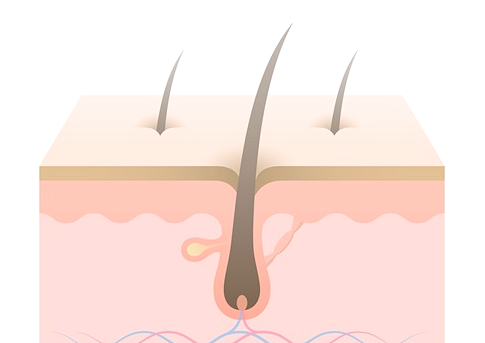
Anatomy illustration related to What Should You Check to Reduce Side Effects from Laser Hair Removal?
02

Why does the interval between sessions affect the result?

Key point
Lasers react only to hairs in the growth phase, so an interval of 4 to 6 weeks, the time it takes hairs to pass the resting phase and return to growth, needs to be kept. If the interval is too short, only skin irritation remains without benefit, and the risk of folliculitis rises.

Body hair alternates between a growth phase and a resting phase, and lasers react only to hairs in the growth phase, so sessions need to be timed at intervals of 4 to 6 weeks, when hairs return to the growth phase. Repeating treatment without keeping this interval leaves few hairs to react, so the skin is only irritated, and if the skin loses moisture, problems such as folliculitis can develop.

Sensitive skin needs more time to recover, and without a recovery period, heat damage can build up and cause pigmentation. In such cases, the interval is lengthened and the number of sessions extended, and the output needs to be redesigned to match the way hair becomes finer and less dense with each session.

03

Why does the number of sessions differ from person to person?

Key point
At first, the output for laser hair removal is set low based on coarse hair, but as sessions go on the hair becomes finer, so the output needs to be raised in small steps. Without this adjustment, there may be no visible effect even after 20 sessions.

When asked how many sessions are needed, an average figure can be given, but in practice the course can be longer or shorter depending on the skin and hair, so it is hard to settle on a single number. At first, the output is set low based on coarse hair, but as treatment is repeated and the hair becomes finer and less dense, the output needs to be adjusted in small steps.

If treatment is repeated at the same strength as the first session without adjustment, the finer hair does not absorb the energy, and there may be no noticeable change even after 20 sessions. Changes in the skin and hair need to be checked at every session, and the settings adjusted again to match.

04

What should be checked to have the treatment safely?

Key point
The criteria that separate a safe treatment are whether the device is set with skin and hair thickness in mind, whether the energy is adjusted according to changes during the procedure, and whether aftercare is provided to help avoid side effects. These are worth checking before treatment.

Diagnosing the condition of the skin and hair and planning a treatment strategy requires a direct consultation with the medical team. Approaches that apply the same energy to many people often put patient turnover first.

There are three main points to check during a consultation. Looking at whether the equipment is set for the individual, whether the energy is adjusted according to changes in the skin, and whether attention is paid to aftercare such as soothing and moisturizing can help in judging whether a clinic is a safe choice.

  • Equipment settings — check whether the wavelength and output are matched to each person, taking skin and hair thickness into account
  • Energy adjustment — check whether the energy is adjusted according to changes in the skin as the procedure goes on
  • Aftercare — check whether care such as soothing and moisturizing is explained to help avoid side effects

Hyeran Heo, Medical Director
Doctor's view

How the doctor decides

Hyeran Heo, Medical Director

I look at tailored settings before strength

I do not recommend simply using strong energy to finish quickly. I consider it most important to first check skin tone and thickness, as well as hair thickness and density, and then set the wavelength and output to match.

I lead the consultation myself

Rather than a consultation manager, I sit down with each patient 1:1, examine the skin and hair, and plan the direction of treatment myself. I do not work in a way that puts patient turnover first.

I readjust as sessions go on

I do not keep the strength from the first setting until the end. I watch how the hair becomes finer and less dense, and I adjust the wavelength and output again at every session.

I also take care of aftercare

I do not stop at the procedure itself; I explain aftercare such as soothing and moisturizing to support recovery while reducing side effects.

Summary

In summary

Laser hair removal is a precise treatment in which output and wavelength change with skin tone, hair thickness and the interval between sessions. Rather than strong energy, individually tailored settings and an interval of 4 to 6 weeks are the key to seeing results while reducing side effects. Because hair thickness and density change as sessions go on, the settings need to be adjusted again, and without this process there may be no effect even after 20 sessions. If the skin has darkened or folliculitis has appeared, it is advisable to have the condition checked through a medical consultation.

FAQ

Frequently asked questions

QHow many sessions of laser hair removal are needed?
A

The number needed differs with skin tone, hair thickness and density, so it is hard to settle on a single number. If the output is not readjusted, there may be no effect even after 20 sessions.

QWill stronger output finish the treatment faster?
A

Raising the output without a plan can instead build up heat at the skin surface and lead to burns or pigmentation. The darker the skin tone, the greater this risk.

QHow far apart should sessions be?
A

Lasers react only to hairs in the growth phase, so an interval of 4 to 6 weeks, when hairs return to the growth phase, needs to be kept. If the interval is too short, only irritation remains without benefit.

QWhat should be checked when choosing a clinic?
A

It helps to check whether the equipment is set for the individual, whether the energy is adjusted according to changes during the procedure, and whether aftercare is explained as well.

Hyeran Heo, Medical Director
Medical review
Hyeran Heo, Medical Director
This content is general medical information and may not apply to every individual. Diagnosis and treatment are decided through a consultation.