Centum Lily Clinic Doctor's Column
Dermatology & Aesthetics Column

Why Do Scars Form After Tattoo Removal?

Why scars can form after tattoo removal, and why treatment needs to be adjusted to the condition of each person's skin.

Published 2026-10-19 Updated 2026-10-19 Reviewed by Hyeran Heo, Medical Director

Tattoo removal is a process in which a laser breaks up pigment lodged deep in the skin into fragments so the body can clear them. It may seem that strong energy applied all at once would remove a tattoo faster. In practice, that approach often goes beyond what the skin can tolerate and leads to scarring.

In short, the key to avoiding scars is not to push ahead with the intensity planned at the start. Instead, the skin is assessed at every session and the treatment plan is adjusted. This article explains how scars form and how to judge whether a treatment is being carried out safely.

01

Why do scars form after tattoo removal?

Key point
Tattoo pigment sits deep in the dermis, so it is removed by using a laser to break the pigment particles into fragments that the body then clears gradually. Breaking up pigment inevitably irritates the skin, and if strong energy is applied repeatedly without time to recover, that irritation can remain as a scar.

Tattoo ink lies deep in the dermis rather than on the surface of the skin, so it cannot simply be wiped away. Treatment uses laser energy to break the pigment into fragments that the body clears on its own. This energy also irritates the surrounding tissue, which then needs time to recover.

If strong irritation is applied again before recovery is complete, the skin is pushed past its limit and the result can be pigmentation or scarring. Tattoo removal is safer when the intensity is not pushed hard from the start but is adjusted gradually while watching how the skin recovers.
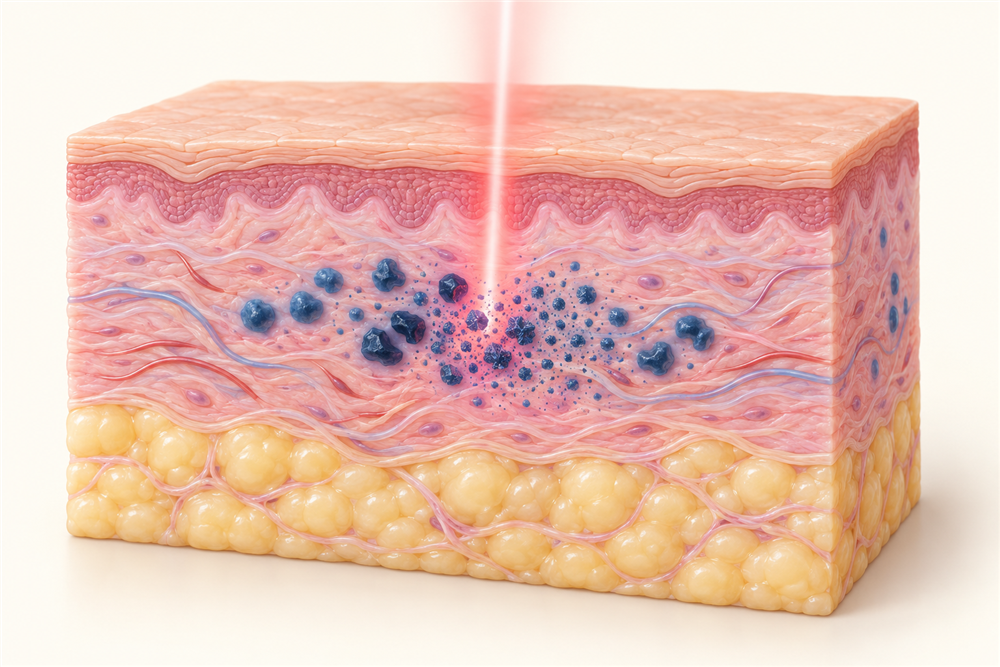
Anatomy illustration related to Why Do Scars Form After Tattoo Removal?
02

Should treatment intensity be adjusted to each person's skin?

Key point
Skin is not the same in every patient. Adjusting the energy level and the interval between sessions individually, based on skin thickness, healing response, skin tone, sensitivity and previous treatment history, helps lower the risk of scarring. Applying one fixed plan to everyone ignores these differences.

On areas where the skin is thin, laser energy that reaches too deep carries a risk of thermal burns, so the intensity has to be lowered, and this is why treatment plans differ from one body area to another. The condition of the skin also changes from session to session, and the intensity needs to be readjusted when the skin is more sensitive.

People whose skin heals more slowly are safer with a longer gap than usual before the next session. When the same plan is applied without taking individual differences into account, the pigment may not fade as expected, and the risk of scarring increases.

  • Skin thickness — thin areas carry a risk of thermal burns, so treatment starts at a lower intensity
  • Healing response — when healing is slow, a longer interval before the next session is safer
  • Skin tone and sensitivity — these change between sessions, so the intensity is reassessed each time
  • Previous treatment history — experience from earlier treatments should be reflected in the current plan
03

Does the treatment differ depending on the tattoo's colors?

Key point
Tattoos differ from person to person in color, size, area covered and how long ago they were done. Because each color responds to a different laser wavelength, the settings have to be matched to the colors present; otherwise the laser does not reach the pigment particles properly and the treatment becomes less effective.

A 1064nm wavelength is used for black tones, 532nm for red tones, and 755nm for green and blue tones. Each pigment absorbs a different wavelength, and only the matching wavelength can break its particles apart.

Treating every color with the same settings, ignoring these differences in wavelength, fails to break up the pigment particles properly, so adding more sessions brings no improvement. Forcing an unsuitable wavelength can also irritate the skin and lead to pigmentation or scarring.

  • Black pigment — a 1064nm wavelength is needed to reach the pigment particles
  • Red pigment — a 532nm wavelength is needed to break the particles down effectively
  • Green and blue pigment — a 755nm wavelength is needed to reach the ink

Anatomy illustration related to Why Do Scars Form After Tattoo Removal?
04

Can you trust claims that a tattoo will fade '100 percent scar-free'?

Key point
Advertisements claiming that a tattoo will disappear cleanly in 10 sessions, or that skin will return to its original state 100 percent scar-free, overlook the fact that every person responds to treatment differently. Such claims call for careful judgment before deciding where and how to be treated.

Fixing the number of sessions, the interval and the intensity in advance is risky. It is like promising when construction will finish without knowing how deep the bedrock lies. Just as builders check each variable as they go, tattoo removal requires the skin to be assessed at every session.

The skin's response to the previous session needs to be checked, with ample time allowed before the next one. Even in a case that progressed to the 3rd session, a visible change came only after the response was reviewed at each session and the intensity and interval were adjusted accordingly.

Hyeran Heo, Medical Director
Doctor's view

How the doctor decides

Hyeran Heo, Medical Director

I do not fix the number of sessions or the intensity in advance

Because every patient's skin and response to treatment are different, I do not tell anyone at the consultation stage, as if it were a set answer, that treatment will be finished in a certain number of sessions at a certain intensity. Rather than deciding the intensity from the start, I believe it is safer to check the response to the first session together with the patient and then plan the next step.

I check the skin myself at every session before planning the next one

I do not schedule the next session simply because the redness has settled. I check the swelling and the irritation response, whether blisters or scabs have formed, and how much pigment remains, and only then do I decide the intensity and the interval for the next session.

I consider whether the medical team handles everything from consultation to aftercare

I regard this kind of judgment as an area that requires an understanding of anatomy. That is why one of my key standards is that the medical team carries the process through from start to finish, covering the consultation, skin assessment, treatment and aftercare.

I match the wavelength to the colors

In my view, black, red, and green or blue pigments each respond to a different laser wavelength. So I first check which colors make up the tattoo, and I believe the laser reaches the pigment particles properly only when I choose and apply the wavelength that suits them.

Summary

In summary

Tattoo removal is a gradual process of breaking down and clearing pigment that has settled deep in the skin. Rather than pushing ahead with the original plan, checking the response at each session and adjusting the intensity and interval is what allows treatment to finish without scarring. Skin thickness, healing response, and the colors and size of a tattoo vary from person to person, so applying the same plan to everyone can be risky. If swelling or irritation lasts a long time, or the pigment does not fade as much as expected, it is safer to have the skin reassessed by a doctor.

FAQ

Frequently asked questions

QHow many sessions does tattoo removal take?
A

The number of sessions depends on the tattoo's colors, size and area, as well as on how each person's skin recovers, so it is difficult to set a fixed number in advance. Treatment proceeds by checking the skin's response after each session and then deciding the timing and intensity of the next one.

QI am worried about scarring. Is there a way to prevent it?
A

The key to reducing scarring is adjusting the intensity while watching how the skin recovers, rather than applying strong energy all at once. This needs to go hand in hand with checking the swelling, the irritation response and the amount of remaining ink at every session.

QMy tattoo has several colors. Can they all be removed at once?
A

Each color responds to a different laser wavelength, so black, red, and green or blue pigments need to be treated with the wavelength that suits each of them. The order and method of treatment may differ depending on the mix of colors.

QWhat should I do if swelling or scabs appear after treatment?
A

Swelling, blisters and scabs are reactions that can appear during healing, and the interval before the next session is set after checking them. If they last longer than usual, it is advisable to have the skin examined by a doctor.

Hyeran Heo, Medical Director
Medical review
Hyeran Heo, Medical Director
This content is general medical information and may not apply to every individual. Diagnosis and treatment are decided through a consultation.