Centum Lily Clinic Doctor's Column
Dermatology & Aesthetics Column

Laser Hair Removal: How Many Sessions Do You Need to See Results?

How laser hair removal works and the treatment interval guidelines that help improve its effect.

Published 2026-10-26 Updated 2026-10-26 Reviewed by Hyeran Heo, Medical Director

Laser hair removal is often described as making hair disappear completely after just a few sessions, but in reality the result varies with hair thickness, skin condition and the interval between sessions. The laser targets the hair root beneath the skin, not the hair that has already grown, and an effect can be expected only when it reaches follicles in the growth phase, so getting the timing right determines the result.

This article covers, in order, how laser hair removal works, how it differs from waxing, and the treatment intervals that improve its effect.

01

How does laser hair removal stop hair from growing?

Key point
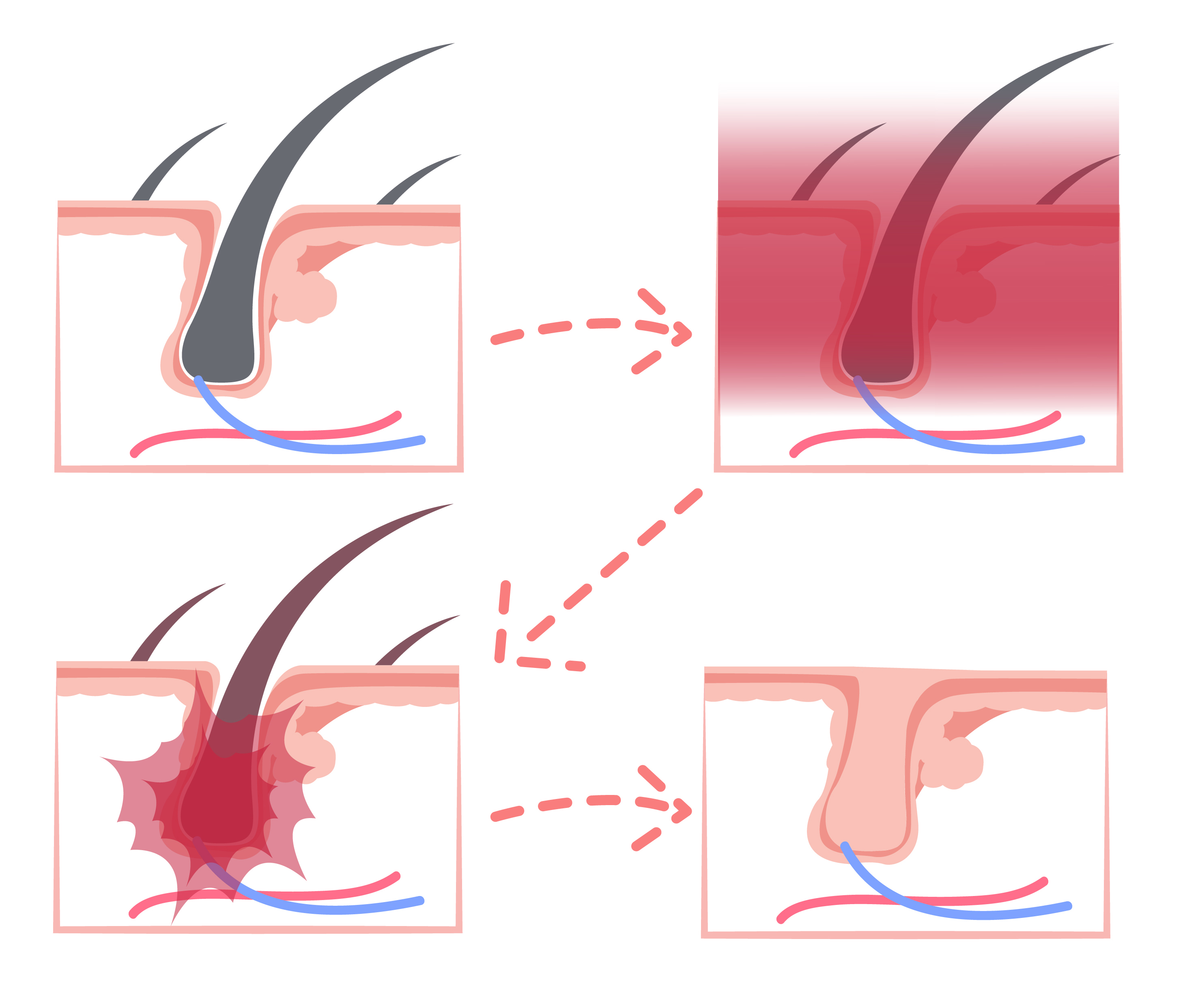
Laser hair removal is a treatment in which light reacts with the melanin pigment in hair, and the resulting heat selectively destroys the hair root and follicle. Its principle is fundamentally different from methods such as shaving, which cuts the hair off.

When the laser penetrates the skin, the melanin pigment in the hair absorbs its energy, and the absorbed energy turns into heat that damages the hair root and follicle tissue. As a result, the hair is not pulled out immediately; instead, the follicle's function weakens, and the speed and thickness of new hair growth gradually decrease.

This is also why laser treatment is less effective after waxing. Hair that has been pulled out by the root no longer contains melanin pigment for the laser to react with, so the laser cannot properly target the hair root. Shaving is recommended before treatment for the same reason.

  • Anagen (growth phase) follicles — the phase when follicles react strongly to laser energy and hair removal is most effective
  • Catagen (regression phase) follicles — a stage when follicle activity weakens and the response to the laser decreases along with it
  • Telogen (resting phase) follicles — a phase when follicle activity has stopped, making it difficult for the laser to detect pigment
Anatomy illustration related to Laser Hair Removal: How Many Sessions Do You Need to See Results?
02

What is the difference between waxing and laser hair removal?

Key point
Waxing pulls hair out by the root, which raises concerns about skin irritation, folliculitis and pigmentation. Laser hair removal, by contrast, selectively destroys the hair root, so it causes less irritation and can be expected to give a long-lasting reduction in hair growth.

Waxing involves pressing wax firmly onto the skin and then removing it in a single pull to take the hair out. It is common for the skin to turn red or feel stinging right after the procedure, and repeated waxing can lead to folliculitis or pigmentation.

Laser hair removal does not physically tear at the skin surface; instead, it weakens the function of the hair root with heat energy. It therefore causes relatively less irritation, and after a certain number of sessions, a long-lasting effect can be expected.

03

How are the number of sessions and the interval decided?

Key point
Areas where hair grows quickly, such as the underarms, are often treated in about 5 sessions at intervals of 3 to 4 weeks, while areas where hair grows slowly, such as the arms or legs, are treated at 6-week intervals, an approach that matches the hair growth cycle.

The appropriate number of laser hair removal sessions varies with the area, hair thickness and hair density, so it is difficult to give a single fixed number. For the female underarm, however, about 5 sessions are generally recommended.

The most important point in setting the interval is timing each session to when follicles are in the growth phase. The effect can be improved by treating the face or underarms at intervals of 3 to 4 weeks, and the arms or legs at 6-week intervals.

04

What should I pay particular attention to before and after treatment?

Key point
After treatment, sun protection, moisturizing and keeping to the treatment schedule are directly linked to the result. Avoiding activities that add heat and friction to the skin, such as saunas or strenuous exercise, is the way to protect both recovery and the effect of the next session.

Skin that the laser has passed over is in a state similar to mild heat damage, so it is sensitive right after treatment. Exposure to UV light carries a risk of pigmentation or burns, which makes sun protection important.

Activities that raise body temperature rapidly, such as saunas or strenuous exercise, can irritate sensitized skin, so it is better to hold back from them for a while. Continuing to moisturize and keeping to the set treatment schedule help maintain the effect.

  • Thorough sun protection — basic care that reduces the risk of pigmentation and burns on skin that is sensitive right after treatment
  • Avoiding saunas and strenuous exercise — activities that raise body temperature rapidly can further irritate sensitive skin
  • Careful moisturizing — helps heat-stressed skin recover and keeps it in good condition until the next session
  • Keeping to the treatment schedule — having sessions too often or leaving the interval too long reduces the response to the laser

Hyeran Heo, Medical Director
Doctor's view

How the doctor decides

Hyeran Heo, Medical Director

I do not fix the number of sessions in advance

I do not tell patients in advance that treatment will be finished after a set number of sessions. Real results come only when I first look at hair thickness, skin sensitivity and hair density, and then build a plan to match them. Even in the same area, the condition of the hair roots differs from person to person, so results have been better when I checked thoroughly at the first consultation and then made a separate plan for each area.

I look at the interval first

I do not think that having treatment more often makes the results come faster. I believe results that match the growth cycle come from setting different intervals for areas where hair grows quickly, such as the face or underarms, and areas where it grows slowly, such as the arms and legs. I do not recommend shortening the interval on your own, and at the first consultation I explain the expected interval for each area.

I make sure patients do not feel rushed if the first session brings little change

I sometimes hear that people did not feel a big change after their first session. I explain that, because this treatment reacts strongly only with follicles in the growth phase, changes often appear over time, and I guide patients to keep to the set intervals. Rather than rushing to add more sessions, I usually suggest that we keep to the set intervals together and watch how things progress.

Summary

In summary

Laser hair removal is a treatment whose results build up only when it is repeated in line with the follicle growth cycle, and keeping to the interval is as important as completing the number of sessions. Even if the first session brings little noticeable change, a reduction in hair thickness and density can be seen after a few more sessions at the recommended interval. If you have questions, it is a good idea to have your hair condition and treatment plan checked again at a consultation.

FAQ

Frequently asked questions

QDoes laser hair removal work after just a single session?
A

Some change may be noticeable, but because the laser reacts strongly only with follicles in the growth phase, treatment needs to be repeated several times to achieve a long-lasting effect.

QDo I really need to keep to the treatment interval?
A

If the interval is too short, follicles in the resting phase are also stimulated, and if it is too long, the response can drop, so keeping to the recommended interval is the better approach.

QCan I switch from waxing to laser hair removal?
A

Yes, but when hair has been pulled out by the root through waxing, there is no pigment left for the laser to react with, so it is better to prepare with a light shave before treatment.

QCan I go to a sauna or exercise right after treatment?
A

Right after treatment the skin is sensitive, in a state similar to heat damage, so holding back for a while from activities that raise body temperature rapidly helps recovery.

Hyeran Heo, Medical Director
Medical review
Hyeran Heo, Medical Director
This content is general medical information and may not apply to every individual. Diagnosis and treatment are decided through a consultation.