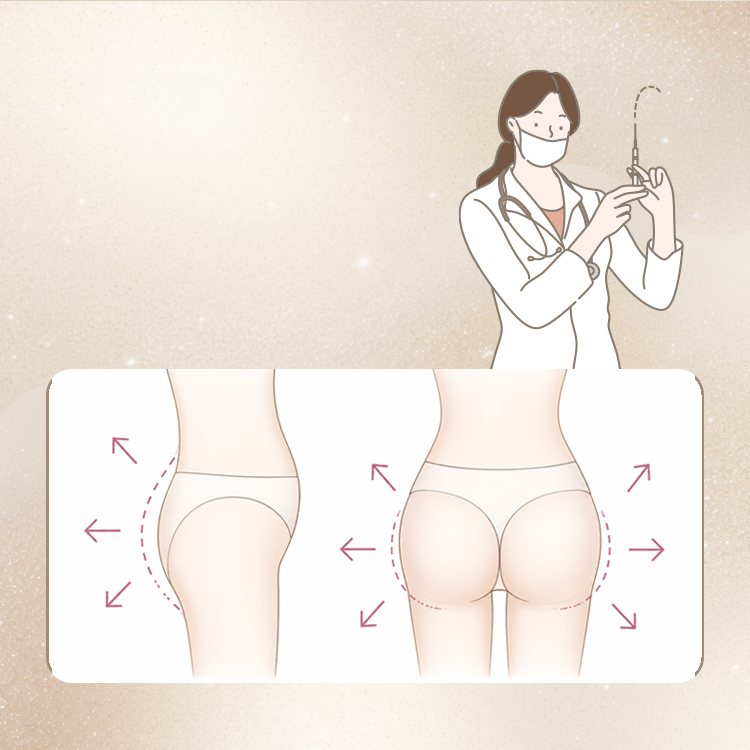
A hip dip is the area below the pelvis and above the thigh that looks hollow when seen from the side, and medically it is described as a depression in the greater trochanter area. It stems from the natural structure of the bones, so it is not filled in by exercise.
This column sets out the criteria to check before price when considering hip dip or pelvic filler. To give the conclusion first, the three most important things are a face-to-face consultation with the medical team, a volume plan matched to the body shape, and a precise molding process.
Why do hip dips form?
A trochanteric depression forms because of the anatomical structure between the pelvic bone and the femur, and it can appear in anyone regardless of body type, differing only in degree. The depression shows more clearly in people with a high or wide pelvis, or with thigh bones that angle outward.
This area is not filled in by reducing body fat or repeating strength exercises. Because the bone frame itself is the cause, diet or lower-body exercise alone is unlikely to lead to the expected result. To change the line, methods such as filler that fill in for the bone structure come into consideration.
- High pelvis — the greater trochanter area looks relatively deeply hollow
- Wide pelvis — the curve shows more clearly when seen from the side
- Outward — angled thigh bones — the space between the pelvis and the thigh widens, making the depression more pronounced
Is it enough to choose based on price alone?
Unlike the face, hip dip filler does not lead to a satisfying result simply by filling the one hollow area, because if the connection looks broken, the overall silhouette does not come together and the parts look disconnected. In the face, a difference of 1cc can stand out, but the pelvic area is large, so the volume needed varies widely with body shape, up to around 200cc.
For this assessment to be accurate, the body needs to be checked not only while standing but also while walking and sitting, and the differences that appear with viewing angle and lighting need to be checked as well. A procedure that skips this step cannot tell the areas to fill from the areas to leave as they are, so it is difficult to reach a natural line.
- Front pelvic line — the curve from the waist to the pelvis should look natural from the front
- Side and back volume — the contour seen from the side and back should blend with the overall line
- Line from the gluteus maximus to the thigh — the curve from the buttocks down to the thigh should not look broken
Why does the molding process matter?
Molding is the process of applying pressure by hand so that the injected filler forms a natural curve within the tissue, and it is treated as a step that shapes the result as much as the injection itself. Since how carefully molding is carried out matters, a procedure time that is cut excessively short needs to be viewed with caution.
If accuracy drops during this process, the surface can be left uneven, the volume on the left and right can settle differently and lead to asymmetry, or the filler can harden in clumps and form lumps that feel like a foreign body. In many cases, these problems do not resolve on their own over time.
- Uneven line — if pressure is not applied evenly, bumps remain on a surface that was smooth
- Asymmetry — if the volume settles differently on the left and right, the body shape looks off balance
- Lumps — if the filler hardens in clumps, a foreign-body feeling can be felt to the touch